
Neurological Vocational Services (NVS)
NVS is the non-profit organization that supported Neurology Vocational Services Unit (NVSU) for over 30 years. Thank you to all our supporters!
One person, one job at a time
Dear Community Partners
Thank you for the collaboration and support through the years in allowing NVSU to help those with neurological conditions remove barriers to employment. We have enjoyed working with our DVR counselors, clients, and employers. Since Dr. Fraser’s passing, we were able to increase the variety of services, which allowed us to serve more people. We couldn’t be more proud of our work. Our partners have shared that our services have always been creative and client centered. We are very sad that this program is closing.
Thank you again for your support and for helping those with disabilities build community.
If you need assistance after our closure date of 9/1/26 please contact Ha Nguyen (thuha2@uw.edu) at the Department of Rehabilitation Medicine.
Sincerely,
NVSU Team – Aliza Hauser, Barbara Beach, Eleanor Pawley, Ethan Blanco, Linda Wood, and Marie-Yvonne Chase
NVS Board Members - Tim Reeve, Ross Perez, Simone Bruyere-Fraser, Matt Storey, Chris Nefcy, Angela Nefcy, and Gretchen Benson.
The University of Washington School of Medicine Department of Rehabilitation announces that
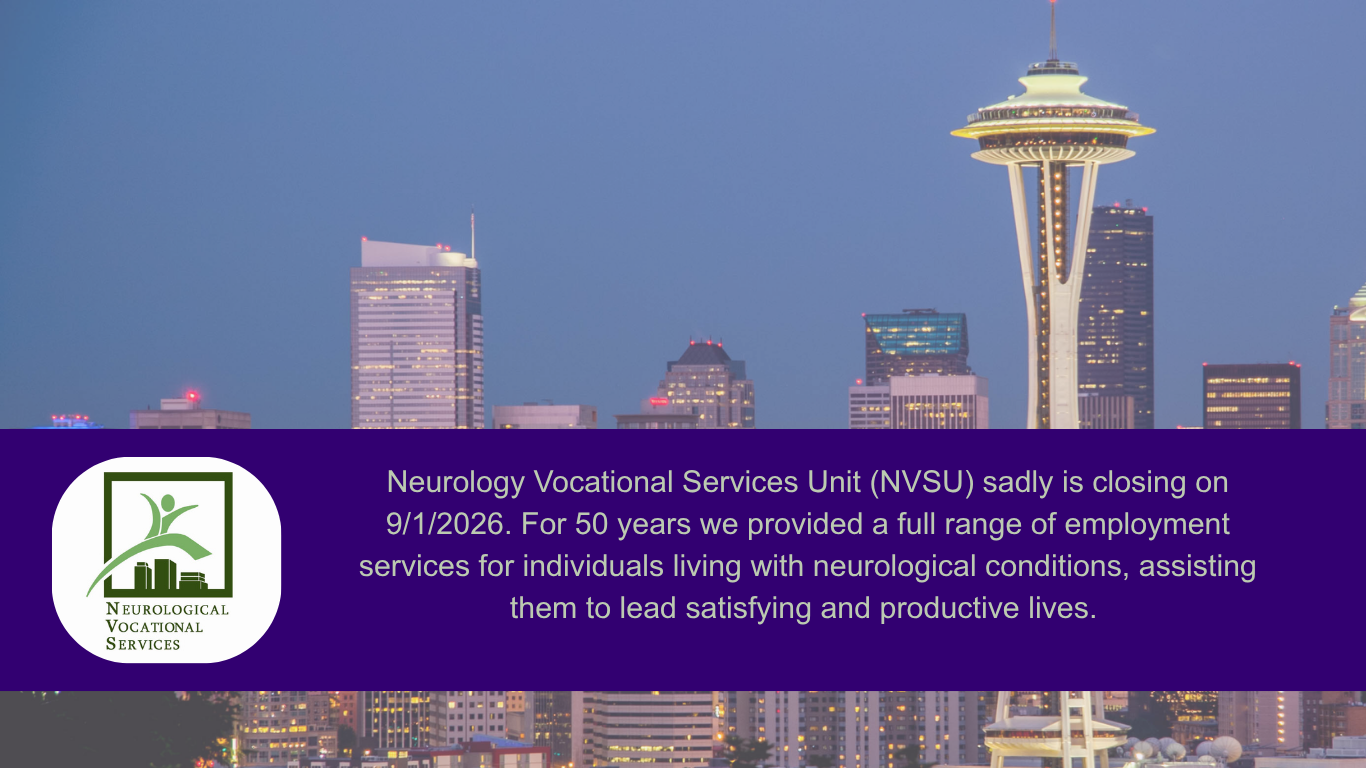
The Neurology Vocational Services Unit will close Sept. 1, 2026, after 50 years of service. The decision was made by the Department of Rehabilitation Medicine after careful consideration of the resources needed to sustain the program over the long term. We recognize that this marks the end of an important chapter for many staff, partners, and participants. While this is a difficult transition, we are deeply grateful for the dedication, expertise, and compassion that have defined the program throughout its history and enriched the lives of those it served.
Since 1976, the Neurology Vocational Services Unit has helped people living with, initially with epilepsy, then growing to neurological conditions, including traumatic brain injuries, stroke, epilepsy, multiple sclerosis, autism spectrum disorder, attention-deficit/hyperactivity disorder (ADHD), visual impairment, and other neurological conditions, pursue meaningful employment and greater independence. Dr. Robert T Fraser PhD, CRC worked tirelessly through research and direct service to enhance employment for people with these specific disabilities. Working in partnership with the Washington State Division of Vocational Rehabilitation and Department of Services for the Blind, the program provided individualized vocational rehabilitation services and helped countless people find and maintain employment. Its legacy will endure through the lives it has changed and the opportunities it helped create over five decades.
“NVSU played a crucial role in setting me up to obtain and maintain employment. They helped me refine key skills such as reading and interpreting body language, which enhanced my communication and understanding in professional settings. The program also emphasized the importance of appropriate self-disclosure, ensuring I knew how to balance sharing personal information while maintaining professionalism. Through their focus on professional communication, I became more effective in my interactions with colleagues and supervisors. Additionally, I learned how to be approachable and manage impulsivity, both of which have been vital in fostering positive work relationships and navigating workplace dynamics.”
“Social skills not only helped me with not only what I can look for with social ques, but it also helped with effective listening”
“I will continue to use and practice my skills in the future!”
“The class helped me disclose and be more aware of my ticks!”
“I feel more confident in handling conflicts better”
“[The topics] were all new and full of information critical to the development of my nearly non-existent social skills”
Dr. Robert T. Fraser Tribute
We honor the memory of Dr. Robert “Bob” Fraser, PhD, MPA, a dedicated faculty member at the University of Washington. Dr. Fraser developed the Neurological Vocational Services Unit in the 1970s, realizing his vision of supporting people through employment services. He began with individuals diagnosed with epilepsy and quickly expanded to serve those with a wide range of neurological conditions due to the high demand for his quality support. His extensive research, numerous publications, and commitment to rehabilitation psychology made a profound impact on the field. Dr. Fraser emulated loving what you do and doing what you love, with family, friends, and collaborators. Dr. Fraser’s legacy continues to inspire and guide our mission, and to honor his remarkable work, we created the Robert T. Fraser Giving Society. Through this society, we celebrate his memory and ensure his vision of empowering individuals through vocational services endures. He will be deeply missed by his colleagues, patients, and community.
For more information, please visit In Memoriam: Robert "Bob" Fraser.
